
Doctoral Student’s Presentation Earns Second Place in 3MT
Cheepilla brings Mitragyna speciosa research into focus in three minutes
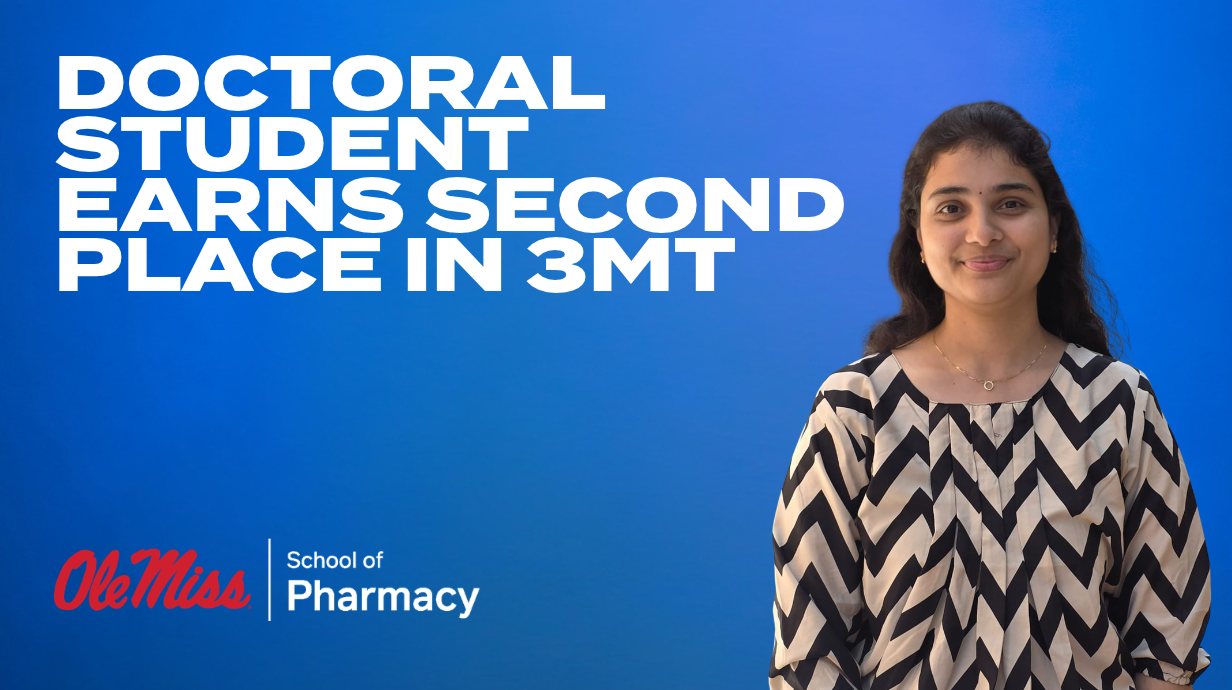
OXFORD, Miss. – Lochana Cheepilla had three minutes to explain months of laboratory research to a panel of judges who were not necessarily scientists. When the final round of the Three-Minute Thesis Competition ended, she had earned second place in the doctoral category.
The final round took place Nov. 4 at the university’s Jackson Avenue Center. Cheepilla, a doctoral student in pharmaceutical sciences with an emphasis in pharmacognosy, presented “Exploring Herb-Drug Interaction Potential of Mitragyna speciosa,” a talk examining how kratom may influence the way the body processes medications and its potential implications for medication safety.
“I never thought I would make it this far, so receiving second place was incredibly exciting and rewarding,” Cheepilla said. “It was a proud moment for me.”
Cheepilla, third-year Ph.D. student under faculty advisor Dr. Ikhlas A. Khan, has conducted research focusing on how kratom interacts in the body, a question with real consequences for anyone who combines herbal products with medication.
“Lochana is a dedicated student and a disciplined researcher,” Khan said. “She developed an excellent presentation highlighting her work, and I'm proud of her performance.”
Cheepilla learned about the competition last year and attended the event, but only as a spectator. This year she decided to compete.
In the first round, contestants delivered three-minute talk on their research to a panel of judges. About 100 students participated, and 25 advanced to the final round.
“My research background is in cell biology and pharmacognosy, where we often use complex scientific terminology,” Cheepilla said. “The biggest challenge was explaining my research in a way that people without a scientific background could understand and appreciate its importance. Receiving second place gave me confidence that I could communicate my work effectively beyond the scientific community.”
Cheepilla plans to finish her degree in 2029 and hopes to stay in the field as a research scientist in the United States. She’s thankful for the opportunity to share her research with a broader audience and shares credit with Khan.
“I could not have done this without Dr. Khan’s guidance,” Cheepilla said. “He has been a great resource for me and very supportive of my research.”
By
James Dowd
Campus
Office, Department or Center
Published
November 23, 2026