Gochfeld Retires From University, Helms Global Science Journal
Research scientist dives into new role as chief editor of Reef Encounter
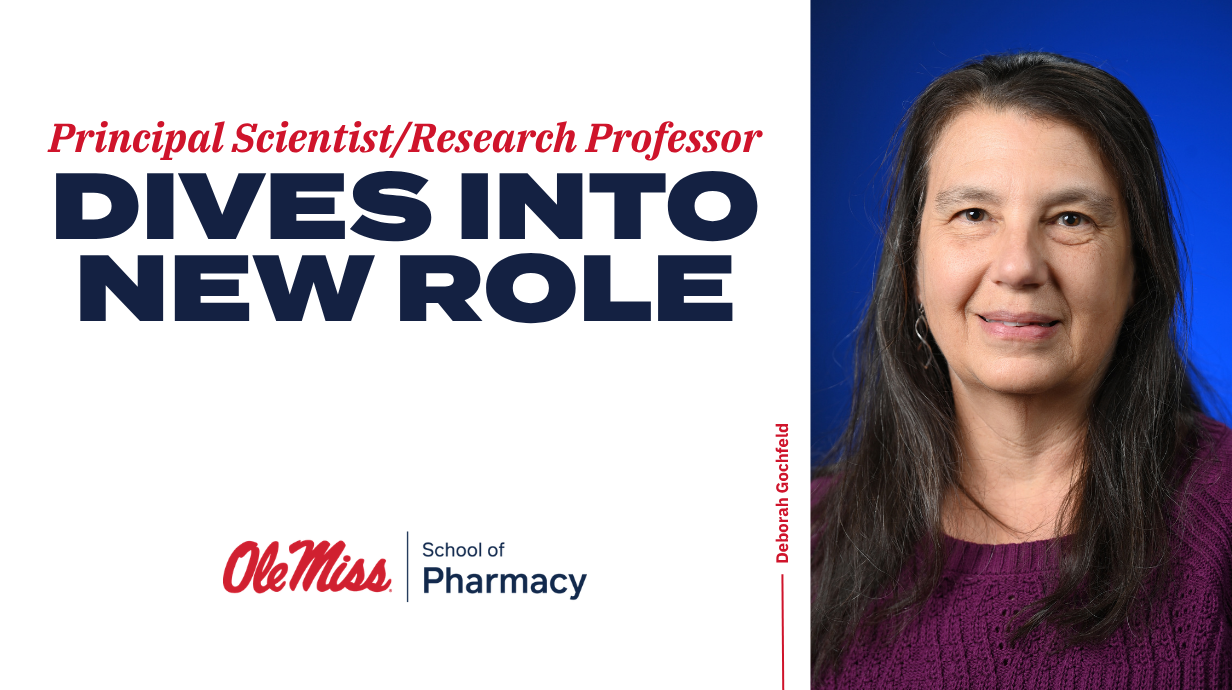
OXFORD, Miss. – Throughout her career, Deborah Gochfeld has studied how coral reefs defend against predators, respond to warming oceans, and how they might be coaxed into yielding compounds that fight diseases. Now after nearly 30 years, she’s retiring as a principal scientist in the University of Mississippi’s National Center for Natural Products Research, and focusing on her new role as chief editor of Reef Encounter, the news journal published by the International Coral Reef Society.
“As a renowned marine biologist, Deborah has brought great recognition to the center, and we’ll miss her,” said Ikhlas Khan, director of the National Center for Natural Products Research. “We wish her the best for the next chapter of her life, and thank her for many years of service to the NCNPR.”
Gochfeld’s first issue as chief editor will publish in December. She also serves on the council of the ICRS, which counts nearly 2,000 members and has a mailing list of more than 10,000 subscribers. The society’s recent international conference drew some 2,100 attendees from 91 countries.
“It’s a labor of love to oversee a publication that highlights research from all over the world,” said Gochfeld, who has written articles for Reef Encounter and served on its editorial panel for several years. “It’s pretty cool to to serve a diverse global community of members who are passionate about this area of research.”
Gochfeld’s route to coral reef science wasn’t a straight line. In college, she was immersed in a pre-med program, until a study-abroad course in St. Croix changed her trajectory. Gochfeld loved the experience so much that she changed her major to marine biology and never looked back.
She went to graduate school at the University of Hawaii, studying coral reef ecology in a program that opened doors to research in Papua New Guinea and beyond. During her years in school, Gochfeld said the central question in the field was simply how coral reefs work. Today, the focus is on how to save them.
“There's no simple answer, and there’s no quick solution, but there’s reason for hope,” Gochfeld said. “Many of the problems affecting reefs, like runoff and disease, can be tackled on a local or regional scale, and while these issues can’t be resolved overnight, researchers around the world are working to help corals become more resilient.”
Gochfeld arrived at Ole Miss in 1998 as a postdoctoral researcher, drawn by funding through the National Institutes of Health and an interest in predator-prey interactions. Over the years she taught several classes, but concentrated on research and mentoring undergraduate and graduate students.
“I’ve always found research to be personally rewarding, because I like being presented with questions and working to find the answers,” Gochfeld said. “I’ve enjoyed my time here, and I’ve had the privilege of working with dedicated colleagues and interacting with talented students.”
In retirement, Gochfeld plans to finish a few papers already in progress, while directing significant attention to her new editorial responsibilities. She's also looking forward to more diving, more travel, and more time with family.
“I think now is a good time to head out and move on, and I’m open to seeing what happens,” Gochfeld said. “I’ll keep my little fingers in coral reef science, because I don’t view this as changing my interests, just changing the way I spend my days.”
By
James Dowd
Campus
Office, Department or Center
Published
September 18, 2026