Faculty Exchange Sparks Pharmacy Education Innovation at Ole Miss
SEC travel grants expand collaboration across campuses
OXFORD, Miss. – University of Mississippi School of Pharmacy faculty will travel to Georgia, Kentucky and Texas this academic year as part of the SEC Faculty Travel Grant Program, while an Auburn University faculty member will visit Oxford through the same exchange.
The program is designed to encourage collaboration, scholarly exchange and stronger relationships among SEC institutions.
For Ole Miss faculty, the visits offer an opportunity to see how other pharmacy schools approach similar areas of teaching, training and practice, then bring those ideas back to their own programs.
Adam Pate, chair and clinical professor of pharmacy practice, said Ole Miss has participated in the program for several years and has encouraged faculty members to apply when their work could benefit from connecting with colleagues at another SEC institution.
“I think that’s what’s nice about the program,” Pate said. “It stimulates an overall cross-pollination of ideas and people.”
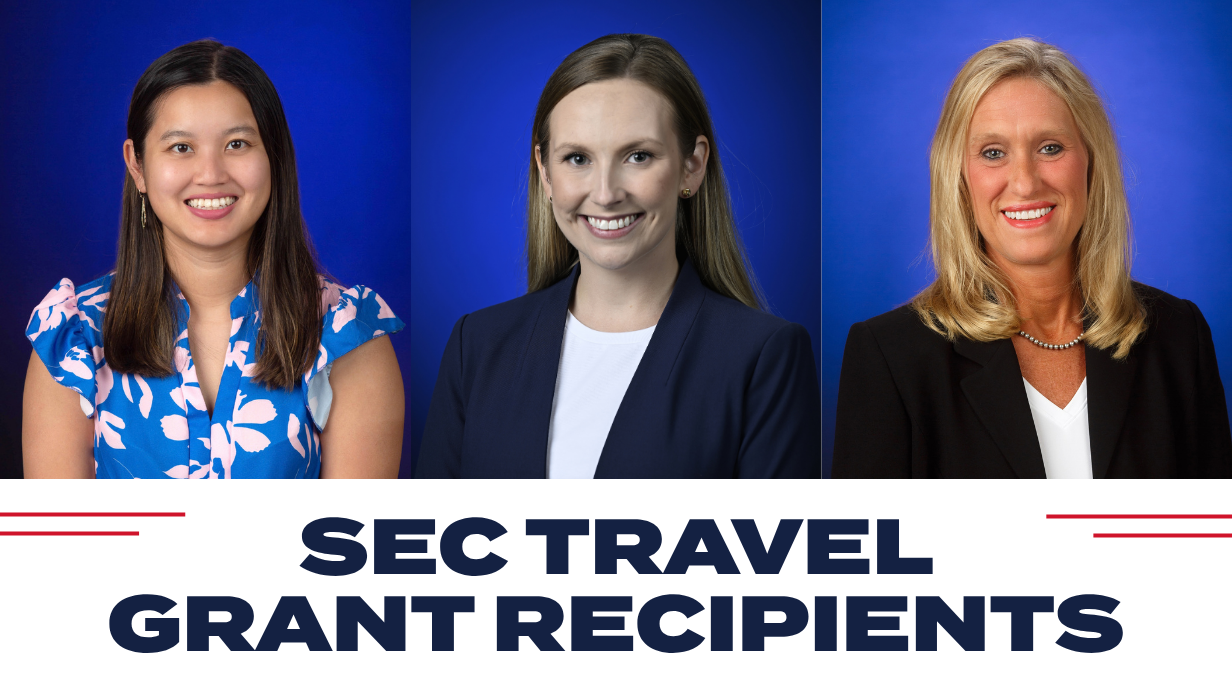
As part of this year’s program, Ha Phan will travel to the University of Georgia, Julie Feimster will visit the University of Kentucky and Kim Adcock will travel to the University of Texas at Austin. Lena McDowell of Auburn University will travel to Ole Miss.
Phan said Georgia stood out because its College of Pharmacy and the University of Mississippi School of Pharmacy face some of the same challenges.
“I chose UGA as I believe their program may face similar conditions or opportunities like our program does with having multiple campuses, like Oxford and Jackson,” Phan said.
During her visit, Phan plans to observe how Georgia delivers its curriculum across campuses and identify approaches that could help Ole Miss as it undergoes curriculum changes. She also hopes to learn about Georgia’s ambulatory care residency program and interprofessional education efforts.
“I would like to observe and experience to see how we can optimize or improve how we provide curriculum across our two campuses,” Phan said.
Feimster will travel to Kentucky in mid-October to study pharmacy practice education and skills-based laboratory training. She is particularly interested in Kentucky’s Patient-Centered Care Experience, a six-semester sequence that combines laboratory, experiential and service-learning activities.
She also plans to examine Kentucky’s learning model, which brings first, second and third-year pharmacy students together, as well as the physical spaces and technology used for instruction.
“I hope to bring back innovative and sustainable practices in teaching pharmacy practice skills and drug knowledge,” Feimster said.
She also wants to identify better ways to align pharmacy practice skills with experiential education and prepare students for professional practice.
Adcock’s visit to Texas will focus on interprofessional education, in which pharmacy students learn alongside students in medicine, nursing, social work and other health disciplines. Through patient cases, simulations and team-based activities, students learn to communicate across professions and provide collaborative care.
Adcock said Texas stood out because of its comprehensive approach to preparing students for collaborative health care. She is particularly interested in how its Center for Health Interprofessional Practice and Education uses micro credentials, or digital badges, to recognize and document students’ interprofessional learning.
“Ultimately, interprofessional education is not just about learning to work together,” Adcock said. “It is about empowering students to create positive change in the way health care is delivered.”
Adcock will focus on learning how Texas structures those experiences, assesses students’ competency, and tracks their achievements across programs. She also sees opportunities for future research, faculty development and shared educational resources between the institutions.
While Ole Miss faculty will carry ideas home from other campuses, the program will also bring an outside perspective to Oxford.
McDowell, an Auburn faculty member and former Ole Miss community pharmacy resident, will visit the university to learn about community pharmacy and on-campus pharmacy services.
She is particularly interested in CPESN Mississippi initiatives that connect patient care, education and community engagement. McDowell also plans to observe how Ole Miss supports innovation in community pharmacy practice and involves students in new patient care models.
“Ole Miss has demonstrated a strong commitment to community pharmacy innovation, experiential education and community engagement,” McDowell said. “I was particularly interested in learning more about how their pharmacy services support both patient care and student learning.”
McDowell expects to bring ideas back to Auburn that can strengthen community pharmacy partnerships, experiential education and future collaborations.
“Programs like the SEC Faculty Travel Grant Program allow faculty to learn from one another, share ideas and build collaborations that enhance teaching, scholarship and service across institutions,” McDowell said.
Pate said the program’s larger goal is for those relationships and conversations to continue after the visits conclude.
“The more we share our experiences, what we’re doing and what we’re seeing, the better off we are,” Pate said.
By
Kylie Eggert
Campus
Office, Department or Center
Published
September 21, 2026